

Galena ROC Express Now Open

ROC Express located in Galena right off Mount Rose Highway, is NOW OPEN. Urgent orthopedic care serving South Reno.

ROC Express

Chad Watts, MD

  • Specialities

    Joint Replacement, Minimally Invasive Joint Replacement, Robotic Knee Replacement, Direct Anterior Hip Replacement, Outpatient Total Joint Replacement Surgery, Partial Knee Replacement, Same Day Surgery, Revision Knee Replacement

  • Fellowship

    Joint Replacement - OrthoCarolina Hip & Knee Center

  • Residency

    Mayo Clinic

  • Medical School

    University of Nevada, Reno School of Medicine

  • Board Certified by the American Board of Orthopaedic Surgery

About Chad Watts, MD

Dr. Watts is a board-certified and fellowship-trained orthopedic surgeon, specializing in hip and knee replacement. He completed his residency training in orthopedic surgery at the Mayo Clinic in Rochester, Minnesota and his fellowship in advanced hip and knee reconstruction techniques at OrthoCarolina in Charlotte, North Carolina.  After his fellowship, he was offered a coveted position to join the surgical staff at the Mayo Clinic but chose instead to return to Reno to be closer to family.  He performs roughly 1,000 hip and knee replacements per year, ranking him among the top joint replacement surgeons in the country.

He has nearly forty publications in the orthopedic literature related to hip and knee replacement, has presented at numerous regional and national meetings, and has received awards for his research from the American Academy of Orthopedic Surgeons, the American Association of Hip and Knee Surgeons, and the Mayo Clinic Department of Orthopedic Surgery. He is a reviewer for orthopedic journals including the Journal of Arthroplasty, the Bone and Joint Journal, and Clinical Orthopedics and Related Research.

His areas of expertise include:

  • Direct Anterior Total Hip Replacement (Arthroplasty)
  • Total Knee Replacement
  • Partial Knee Replacement
  • Revision and Complex Hip and Knee Replacement
  • Robotic Joint Replacement Surgery (Certified in MAKO, Navio, and Cori robotics)
  • Outpatient Same-Day Joint Replacement Surgery
  • Minimally Invasive Surgical Techniques
  • Custom Knee Replacement (Conformis or Restor3D)
  • Quadricep Sparing Knee Replacement
I am a new patient at ROC and I had experienced some anxiety prior to my hip replacement evaluation. I found that Dr. Chad Watts and his staff were willing to take the time necessary to answer my questions in detail. Dr. Watts obviously has a lot of experience with this procedure and after reviewing my x-rays I felt comfortable knowing that Dr. Watts is the right person for the job.

Knee Replacement FAQs - Chad Watts, MD

Where will the incision be?

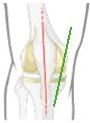
In most cases, the incision will be toward the medial/inside part

of your knee (green line), rather than the traditional midline incision

(red line). This may be different if you have old incisions from previous surgeries.

What is quadriceps-sparing knee replacement?

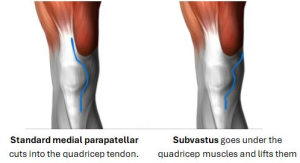
Dr. Watts uses this muscle-sparing technique (subvastus exposure) to avoid cutting into the quadricep tendon by gently moving the muscle aside to reach the joint.

The result: less pain and faster recovery for many patients.

What is a Jiffy Knee™ replacement?

Jiffy Knee™ is simply a marketing platform some surgeons use to advertise that they use a quadriceps-sparing (subvastus) approach. It refers only to the exposure (the first 2 minutes of the surgery) and does not refer to a specific implant or technology. Dr. Watts does not pay for the marketing service but does use a muscle sparing approach for knee replacements.

Dr. Watts learned this technique during his training at the Mayo Clinic and uses it combined with robotic or custom technology for added precision and personalization.

Will I go home the same day or stay overnight after surgery?

Most patients go home the same day after their knee replacement. If your surgery is at Reno Orthopedic Surgery Center (ROSC), you’ll be up walking and practicing stairs within an hour and typically ready to go home within two hours.

If you have medical conditions or need extra help at home, your surgery can be done at a hospital where you may stay overnight.

How long does surgery take?

Most knee replacements take 30–45 minutes, plus time before and after for anesthesia and preparation.

When can I walk after surgery?

You’ll be full weight-bearing right away. Most patients are walking within an hour of surgery. You will use a walker at first.

When can I drive again?

· Left knee: Usually within 1-2 weeks.

· Right knee: Usually within 3-4 weeks.

You may drive once you feel comfortable, have good control, and are no longer taking narcotic pain medication. Always practice driving in a safe environment first.

What activities can I return to after surgery?

Most patients return to favorite activities such as biking, hiking, golf, skiing, pickleball, or horseback riding once they’ve recovered.

How should I choose a joint replacement surgeon?

· Training: Look for a surgeon with subspecialty training. Dr. Watts completed a dedicated fellowship in hip and knee replacement and stays active in teaching and implant design.

· Facility: ROSC has been recognized nationally for excellence. It was designed by ROC surgeons, anesthesiologists, and nurses to provide an outstanding patient experience.

· Experience: Dr. Watts performs about 1,000 hip and knee replacements each year—more than any other surgeon in the region.

· Communication & Trust: Surgery is a major event—choose someone you feel comfortable with. Dr. Watts and his team (Cory, Cynthia, and Misty) provide personalized care and educational resources to help you prepare.

How can I contact your office?

· MyChart: For most questions.

· Misty (surgery scheduling): (775) 788-5221

· Cynthia (medical assistant): (775) 785-3040

· After-hours urgent line: (775) 786-3040

How successful are joint replacements?

Hip and knee replacements are among the most successful surgeries in medicine. At ROSC, we’re proud of our low complication rates and high patient satisfaction, reflected in multiple national awards.

How can I prepare for surgery?

· Stay as strong and flexible as possible.

· Manage chronic conditions like high blood pressure, diabetes, or sleep apnea.

· Stop all nicotine products, including vaping.

Your preparation helps ensure a smoother recovery.

Will I need physical therapy?

· Knee replacement: All patients should start PT within 7 days of surgery. You need to call to schedule your own PT as soon as you know your surgery date.

What kind of anesthesia will I have?

You will receive a short general anesthetic, as well as a long-acting local anesthetic injected into the surgical site during the surgery and a regional nerve block that typically lasts for 2–3 days.

How much pain should I expect, and how is it managed?

Pain should be expected, but Dr. Watts uses less invasive techniques—like the direct anterior hip and quad-sparing knee approaches—to make recovery easier.

Your pain plan will be personalized and may include:

· Tylenol (acetaminophen)

· Anti-inflammatories (NSAIDs like ibuprofen)

· Muscle relaxers and nerve medications

· Tramadol or short-term narcotics if needed

We’ll review your pain plan before surgery and send prescriptions to your pharmacy. Ice machines are especially helpful after knee replacements.

What equipment will I need after surgery?

· Walker: Everyone starts with one until steady.

· Ice machine: Highly recommended for knee replacements.

· Optional items: Cane, toilet seat riser, shower chair, grabber, or long shoehorn—depending on your needs at home.

How does robotic knee replacement work?

Dr. Watts performs hundreds of robotic knee replacements each year using the MAKO robot. The robot acts like a smart assistant, helping Dr. Watts make extremely precise cuts and measurements for your specific anatomy—resulting in less tissue trauma and a more natural-feeling knee.

Does Dr. Watts perform custom knee replacements?

Yes. When appropriate, Dr. Watts uses custom implants made with Restor3D (formerly Conformis) technology. He’ll review the pros and cons of each option with you.

What is a partial knee replacement?

The knee has three compartments—inner (medial), outer (lateral), and under the kneecap. If arthritis affects only one area, you might be a candidate for a partial knee replacement. Dr. Watts has extensive experience with robotic partial knee replacements and will help determine if it’s right for you.

What is a knee replacement made of?

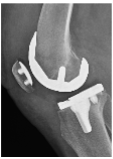
A knee replacement is like a new surface for the knee:

· Metal caps cover the bone ends.

· A durable plastic insert goes between them.

· The underside of the kneecap may also be resurfaced if needed.

·

How long will my knee replacement last?

Modern implants are expected to last 30 years or more for most patients.

Hip Replacement FAQs - Chad Watts, MD

What are the benefits of direct anterior (DA) hip replacement?

This approach uses a small incision at the front of the hip, allowing Dr. Watts to reach the joint between muscles instead of cutting through them. Benefits include:

· Less pain

· No bending precautions

· Faster recovery

Dr. Watts has performed thousands of successful anterior hip replacements.

Will I go home the same day or stay overnight after surgery?

Most patients go home the same day after their joint replacement. If your surgery is at Reno Orthopedic Surgery Center (ROSC), you’ll be up walking and practicing stairs within an hour and typically ready to go home within two hours.

If you have medical conditions or need extra help at home, your surgery can be done at a hospital where you may stay overnight.---

How long does surgery take?

Most hip replacements take 30–40 minutes, plus time before and after for anesthesia.

When can I walk after surgery?

You’ll be full weight-bearing right away. Most patients are walking within an hour of surgery.

When can I drive again?

· Left hip: Usually within 2 weeks.

· Right hip: Usually within 4 weeks.

What activities can I return to after surgery?

Most patients return to favorite activities such as biking, hiking, golf, skiing, pickleball, or horseback riding. There are no long-term restrictions.

How should I choose a joint replacement surgeon?

· Training: Look for a surgeon with subspecialty training. Dr. Watts completed a dedicated fellowship in hip and knee replacement and stays active in teaching and implant design.

· Facility: ROSC has been recognized nationally for excellence. It was designed by ROC surgeons, anesthesiologists, and nurses to provide an outstanding patient experience.

· Experience: Dr. Watts performs about 1,000 hip and knee replacements each year—more than any other surgeon in the region.

· Communication & Trust: Surgery is a major event—choose someone you feel comfortable with. Dr. Watts and his team (Cory, Cynthia, and Misty) provide personalized care and educational resources to help you prepare.

How successful are joint replacements?

Hip replacement is frequently referred to as the most successful surgery in all of medicine. At ROSC, we’re proud of our low complication rates and high patient satisfaction, reflected in multiple national awards.

How can I prepare for surgery?

· Stay as strong and flexible as possible.

· Manage chronic conditions like high blood pressure, diabetes, or sleep apnea.

· Stop all nicotine products, including vaping.

Your preparation helps ensure a smoother recovery.

Will I need physical therapy?

PT is optional for hip replacements. If you’d like to do it, plan to start 2–3 weeks after surgery.

What equipment will I need after surgery?

· Walker: Everyone starts with one until steady.

· Ice machine or ice packs

· Optional items: Cane, toilet seat riser, shower chair, grabber, or long shoehorn—depending on your needs at home.

How much pain should I expect, and how is it managed?

Pain should be expected, but Dr. Watts uses less invasive techniques—like the direct anterior hip and quad-sparing knee approaches—to make recovery easier.

Your pain plan will be personalized and may include:

· Tylenol (acetaminophen)

· Anti-inflammatories (NSAIDs like ibuprofen)

· Muscle relaxers and nerve medications

· Tramadol or short-term narcotics if needed

We’ll review your pain plan before surgery and send prescriptions to your pharmacy. Ice machines are especially helpful after knee replacements.

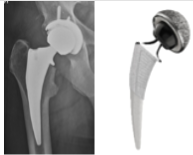
What is a hip replacement made of?

Most modern hip replacements include:

· Titanium socket and stem

· Ceramic ball

· Durable plastic liner

How long will my hip replacement last?

Modern hip replacements are expected to last 50–60 years for most patients.

What technology does Dr. Watts use during hip surgery?

Dr. Watts uses intraoperative fluoroscopy for real-time imaging—providing precise implant positioning, which is how we get the sizing and leg lengths as close as possible.

He also uses a special femoral impactor system that reduces the risk of bone fracture during surgery.

What kind of anesthesia will I have?

You will receive a short general anesthetic, as well as a long-acting local anesthetic injected into the surgical site during the surgery.

How can I contact your office?

Misty (surgery scheduling): (775) 788-5221

Cynthia (medical assistant): (775) 785-3040k

After-hours urgent line: (775) 786-3040

MyChart: for most questions

Online Scheduling: renoortho.com

Physician Assistants